 Alena Tereshko – Garden of Hands
19.07-11.08.2024
Opening / Avajaiset 18.07.2024 18:00-20:00
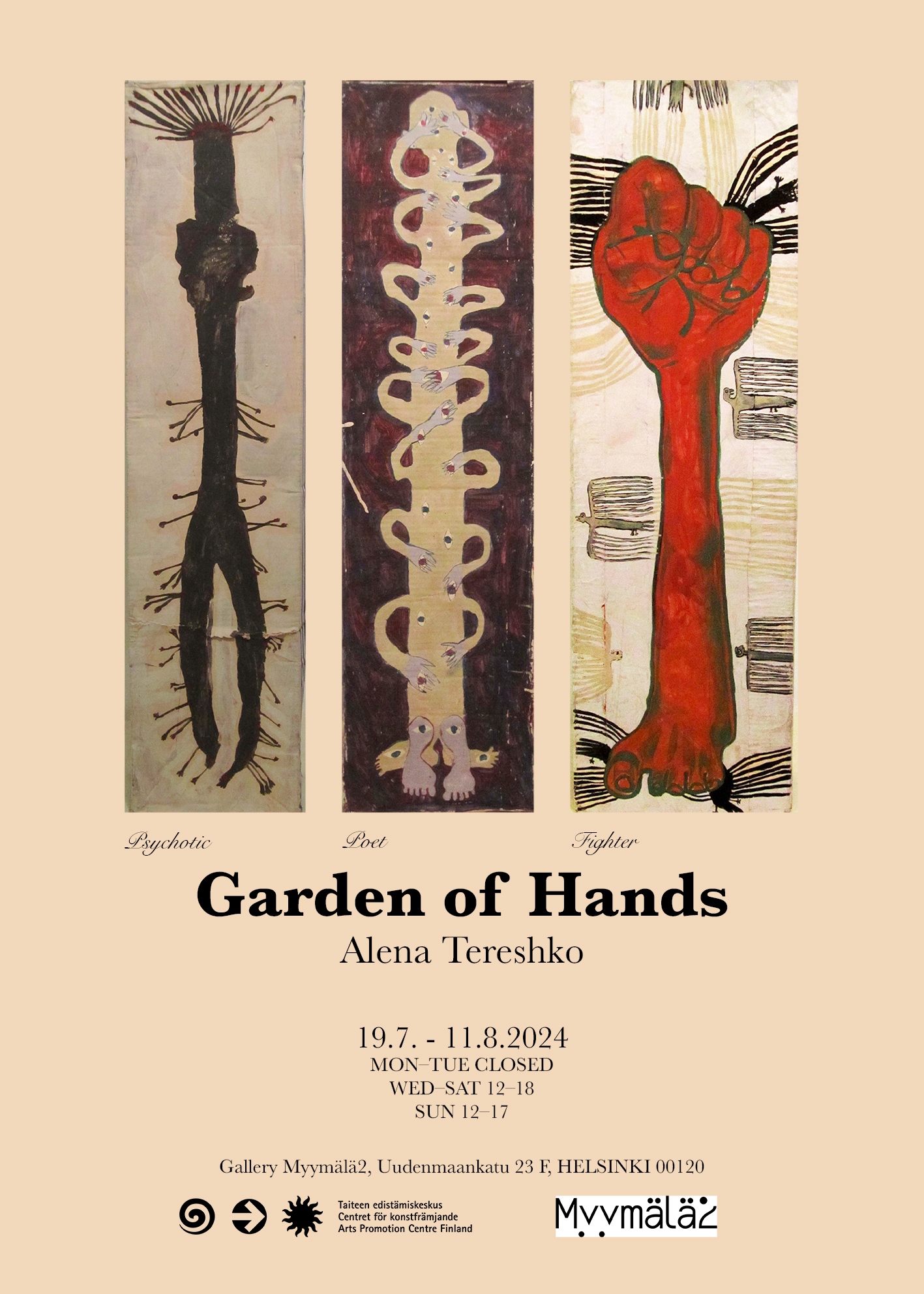
Myymälä2 is pleased to present “Garden of Hands” by Alena Tereshko. At the Garden of Hands, Alena Tereshko presents soft sculptures that appear as assemblages of the hands and other parts of the human body. They are characters with personalities referring to various unspeakable emotional states or tangled relationships with selves and others: for instance, a fighter, or a rebel (“Fist”), the one with multiple arms and eyes (“Hand-raised Worm”), the entangled one, the one that hugs a void, or the choir of rhythmically clapping hands cheering the visitors. Just as attractions in an amusement park, some of these characters invite you to interact with them; the visitors can touch, crumple, or control sculptures with a gamepad, and they respond, for instance, with movements or gentle semi-human, semi-mechanical sounds. The characters form an outlandish yet welcoming playground.
This project grew from the series of paintings Tereshko made years ago. Back then, these characters were depicted in a manner resembling religious paintings or bestiaries. Reworked and revitalized for this show, they enter a certain dialogue with Tereshko’s ongoing project Kotiodysseia, dedicated to stuffed animals and childhood activities growing through the lives of adults. Moreover, the current project continues, with a certain playfulness, her investigation of the body and femininity.
The “petting garden” of soft sculptures invites the audience to play and manipulate it and find joy and relaxation. Tereshko mentions that the objects, because of their materiality and tactility, help to deal with hard emotions and could play a therapeutic role. For some, the need to hold, be embraced, touch, and squeeze soft matters becomes especially evident in living as an immigrant. In this sense, the function of such sculptures recalls the one of a transitional object. According to D. Winnicott, infants use such objects, usually toys or blankets, to cope with the split from their mothers and tolerate separation anxiety. These tangible entities support a softer transition to the external reality in front of which even grown-up individuals become very vulnerable in certain circumstances.
Following the psychoanalytic path, which the artist mentions as crucial for her work, it is easy to draw connections to the notions of the uncanny, that S. Freud developed concerning something both familiar and alien simultaneously, and of the abject, introduced by J. Kristeva, which refers to dangers that body contains, traumatic experience and its reenactment. However, slightly uncanny, and slightly abjectified, these characters are less related to fears and bodily anxiety but rather serve as tools for finding comfort. In a sense, they are grown-up stuffed toys with their own grown-up problems, not too different from us. Tereshko constructs her frivolous cabinet of curiosities with subtle humor and lots of empathy for human conditions and feelings.
Text: Adel Kim.
Artist bio:
Alena Tereshko (1986, Ishim, Tyumen region) studied at The Saint Petersburg Stieglitz State Academy of Art and Design. She works with performance art, video, painting and graphics.
Often, in artistic research she focuses on a body and its representations. Alena is particularly interested in how contemporary phenomena and tradition (folklore or traditional art) are intertwined in the arts. She intrigued by the relationship between images and perception. In general opposite categories and their points of contact fascinate her.
Alena Tereshko is the winner of the Sergey Kuryokhin Prize (2017) in “The Best Media Object” category. She had solo-exhibitions and participated in numerous exhibitions in Russia and Europe. Alena got scholarship residency in Cite des Arts (Paris, 2024), Garage studios (Moscow, 2023), Iaspis (Umeå, Sweden, 2019), Nordland Kulturesenter (Bodø, Norway, 2015).
http://alenatereshko.com/
Credits:
Sound design by Hulda Hjálmarsdóttir and Sofia Zaiceva.
Electronics (design and programming): Marloes van Son, Sofia Haapamäki.
This project is supported by Taike.
Näyttelyssään “Garden of hands” Alena Tereshko esittelee joukon pehmeitä veistoksia jotka näyttävät käsien ja muiden ihmiskehon osien yhdistelmältä. Teokset ovat hahmoja, joilla on persoonallisuus ja jotka viittaavat lukemattomiin vaiettuihin tunnetiloihin ja sotkeutuneisiin ihmissuhteisiin itsensä ja muiden kanssa, kuten esimerkiksi “Fist”, taistelija ja kapinallinen, tai “Hand-raised Worm”, monikätinen ja -silmäinen, kietoutunut hahmo, hän joka halaa tyhjyyttä, tai kuoro joka käsiä taputtaen hurraaa vierailijoille. Kuten huvipuiston kohteet, jotkin näistä hahmoista kutsuvat vuorovaikutukseen itsensä kanssa; kävijät voivat koskettaa, rypistää, tai hallita veistoksia konsolilla, ja nämä reagoivat puoli-inhimillisillä, puoli-mekaanisilla liikkeillä ja äänillä. Hahmot muodostavat omituisen, mutta kutsuvan leikkikentän.
Projekti sai alkunsa Tereshkon vuosia sitten tekemästä maalaussarjasta. Silloin nämä hahmot kuvattiin tavalla, joka muistutti uskonnollisia maalauksia tai bestiarioita. Tätä näyttelyä varten muokattuina ja elvytettyinä ne käyvät vuoropuhelua Tereshkon meneillään olevan Kotiodysseia -projektin kanssa, joka on omistettu aikuisten elämässä oleville lapsuuden leikeille ja pehmoleluille. Lisäksi nykyinen projekti jatkaa tietyllä leikkisyydellä hänen tutkimusmatkaansa kehoon ja feminiinisyyteen.
Pehmeiden veistosten “petting garden” kutsuu yleisön leikkimään ja löytämään iloa sekä rentoutusta. Tereshko mainitsee, että niiden materiaalisuuden ja kosketeltavuuden vuoksi objektit helpottavat vaikeiden tunteiden käsittelemistä ja niillä voi olla luonteeltaan terapeuttinen vaikutus. Joillekin tarve pitää kiinni ja tulla pidetyksi, koskettaa ja puristaa pehmeitä asioita korostuu erityisesti maahanmuuttajana eläessä. Tässä mielessä tämänkaltaisten veistosten tarkoitusperä muistuttaa perinteisiksi miellettyjen esineiden tarkoitusta. D. Winnicottin mukaan pikkulapset käyttävät tällaisia esineitä, yleensä leluja ja peittoja, käsitellessään eroa äideistään ja toleroidakseen eroahdistusta. Nämä konkreettiset esineet edesauttavat pehmeämpää siirtymistä ulkoiseen todellisuuteen, jonka edessä jotkut aikuisistakin voivat tulla erittäin haavoittuvaisiksi.
Seuraten psykoanalyyttistä polkua, jonka taiteilija kertoo olevan tärkeää työlleen, on helppo tehdä yhteyksiä S. Freudin kehittämiin epänormaalin käsitteisiin, jotka koskettavat samaan aikaan sekä tuttua että epänormaalia sekä J. Kristevan esille nostamaan abjektin käsitteeseen, joka viittaa niihin vaaroihin joita ruumis pitää sisällään, traumaattiseen kokemukseen ja sen uudelleen saattamiseen. Kuitenkin, nämä hahmot, ollessaan hieman epänormaaleja, hieman abjektioituneita, eivät niinkään liity pelkoihin tai keholliseen ahdistukseen, vaan toimivat enemmänkin työkaluina turvan löytämiseksi. Tavallaan ne ovat aikuisia pehmoleluja, joilla on aikuiset ongelmat jotka eivät eroa paljoa omistamme. Tereshko rakentaa kevytmielisen kuriositeettikabanettinsa hienovaraisella huumorilla ja suurella empatiakyvyllä ihmisten oloja ja tunnetiloja kohtaan.
Taiteilija Bio:
Alena Tereshko (1986, Ishim, Tyumen alue) opiskeli Saint Petersburgin Stieglitzin osavaltion taiteen ja designin akatemiassa. Hän työskentelee performanssin, videon, maalauksen ja grafiikan parissa.
Usein Tereshko keskittyy taiteellisessa työssään kehoon ja sen representaatioihin. Hän on erityisen kiinnostunut siitä, kuinka nykyajan ilmiöt ja perinteet (kansanperinne sekä perinteinen taide) kietoutuvat taiteessa yhteen. Häntä vetää puoleensa erityisesti kuvien ja havaitsemisen välinen suhde. Yleisesti ottaen, kategoriat ja niiden kosketuspinnat kiehtovat häntä.
Alena Thereshko on Sergey Kuryokhin -palkinnon voittaja (2017) kategoriassa “The Best Media Object”. Hän on osallistunut lukuisiin näyttelyihin sekä pitänyt omia yksityisnäyttelyitään Venäjällä että Euroopassa. Alena on palkittu apuraharesidenssillä seuraavissa kohteissa: Cite de Arts (Pariisi, 2024), Garage studios (Moskova 2023), laspis (Uumaja, Ruotsi 2019), Nordland Kulturesenter (Bodø, Norja 2015).
Kiitos:
Äänisuunnittelu: Hulda Hjálmarsdóttir ja Sofia Zaiceva.
Elektroniikka (suunnittelu ja ohjelmointi): Marloes van Son, Sofia Haapamäki.
Projektia tukee Taike.