
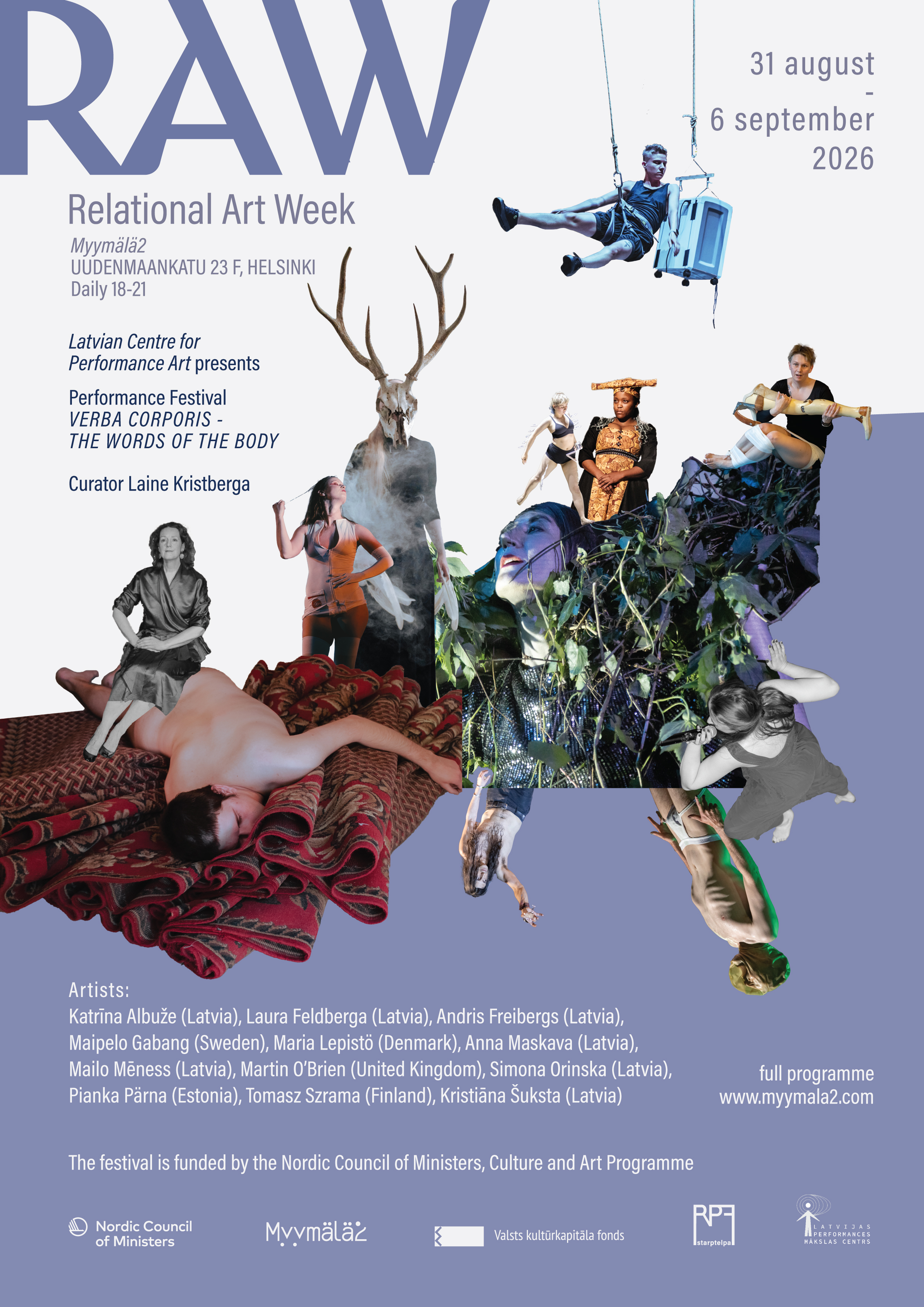
VERBA CORPORIS – THE WORDS OF THE BODY
Relational Art Week
31.8. – 6.9.2026
How does language inhabit the body? What happens when words become material for performance?
Presented by the Latvian Centre for Performance Art as part of RAW 2026 – Relational Art Week, VERBA CORPORIS – The Words of the Body brings together artists from Latvia, Finland, Denmark, Sweden, Estonia, and the United Kingdom. Curated by Laine Kristberga, the festival examines how language inhabits contemporary performance through a series of live works, discussions, and collaborative encounters.
Through twelve live performances, the festival explores the diverse ways in which text can enter performance art: as spoken language, autobiography, recorded voice, instruction, appropriation, memory, and embodied presence.
Artists:
Katrīna Albuže (Latvia), Laura Feldberga (Latvia), Andris Freibergs (Latvia), Maipelo Gabang (Sweden), Maria Lepistö (Denmark), Anna Maskava (Latvia), Mailo Mēness (Latvia), Martin O’Brien (United Kingdom), Simona Orinska (Latvia), Pianka Pärna (Estonia), Tomasz Szrama (Finland), and Kristiāna Šuksta (Latvia).
Video Artists:
style=”text-align: justify;”>Diana Lelis (Latvia), Eliza Eikerte (Latvia), Normal Babyy (Elza Knese and Kristofers Knesis, Latvia), Dāniels Šatalovs (Latvia), Anna Maskava (Latvia)
VERBA CORPORIS brings together artists who engage with text and language as central materials in performance, each approaching them from distinct aesthetic, political, and personal perspectives. Through spoken word, recorded voice, textual appropriation, and embodied practices, the festival highlights the multiplicity of ways in which performance artists work with language. Unlike theatre, where meaning is traditionally rooted in a written play, performance art has often treated text as taboo, associating it with theatricality, mimesis, and excessive meaning-making. VERBA CORPORIS challenges this bias by exploring how text can inhabit performance in diverse forms and modes, opening new possibilities for artistic experimentation and expression.
Programme: twelve live performances, two workshops led by Simona Orinska and Laura Feldberga, video performances, a public discussion, as well as artist talk with Martin O’Brien moderated by Laine Kristberga. Through performances, practical exchange, and critical dialogue, VERBA CORPORIS creates a space for artists and audiences to explore the multiple ways in which text, voice, and language inhabit contemporary performance practices.
The project builds new networks through collaboration between Latvian and Finnish organisations – the Latvian Centre for Performance Art, Gallery Myymälä, Villa Ellaintarha, and UniArts Helsinki – as well as a diverse group of international artists. Bringing together twelve live performances, two workshops, video performances, networking events, as well as a public discussion and artist talk, VERBA CORPORIS creates opportunities for artistic exchange, knowledge-sharing, and meaningful dialogue across disciplines, generations, and national contexts. By fostering new professional relationships and strengthening existing partnerships, the festival contributes to the development of a vibrant and interconnected performance and live art community in the Nordic and Baltic regions. The festival is part of our ongoing Baltic Fellowship program, curated by Ramiro Camelo. The festival is funded by the Nordic Council of Ministers’ Culture and Art Programme.
Free Entrance.
PROGRAMME
MONDAY, 31 AUGUST
Curated Video Programme
📍 Gallery Myymälä2
Video performances by Latvian artists
TUESDAY, 1 SEPTEMBER
Live Performances
📍 Gallery Myymälä2
18:00 — Maria Lepistö (Denmark)
Born to Be Wild
19:00 — Katrīna Albuže (Latvia)
Yes ⇄ No → YES!
WEDNESDAY, 2 SEPTEMBER
Public Discussion
15:00–17:00
📍 UniArts Helsinki
Moderated by Laine Kristberga
Participants:
Maria Lepistö (Denmark)
Maipelo Gabang (Sweden)
Tomasz Szrama (Finland)
Pianka Pärna (Estonia)
Live Performances
📍 Gallery Myymälä2
18:00 — Kristiāna Šuksta (Latvia)
The Death of an Opera Singer
19:00 — Mailo Mēness (Latvia)
This Sentence Needs Your Body
THURSDAY, 3 SEPTEMBER
Live Performances
📍 Gallery Myymälä2
18:00 — Maipelo Gabang (Sweden)
I Am Not Your Tea Girl
19:00 — Laura Feldberga (Latvia)
Miss Riga
20:00 — Andris Freibergs (Latvia)
Absurd Pleasure Machine
FRIDAY, 4 SEPTEMBER
Live Performances
📍 Gallery Myymälä2
18:00 — Tomasz Szrama (Finland)
Communicatio
19:00 — Anna Maskava (Latvia)
You May Have Come from God, but I Came from My Mother’s Vagina
20:00 — Pianka Pärna (Estonia)
marrying liberation
SATURDAY, 5 SEPTEMBER
Workshop
12:00–15:00
📍 Gallery Myymälä2
Simona Orinska (Latvia)
The Feminine: Embodiment, Memory, and Transformation
Artist Talk
17:00–18:00
📍 Gallery Myymälä2
Martin O’Brien (United Kingdom)
Moderated by Laine Kristberga
Live Performances
📍 Gallery Myymälä2
19:00 — Simona Orinska (Latvia)
Femina Corporalis
20:00 — Martin O’Brien (United Kingdom)
This Unending (Doorway)
SUNDAY, 6 SEPTEMBER
Workshop
13:00–16:00
📍 Gallery Myymälä2
Laura Feldberga (Latvia)
Embodied Images: Personal Archive and Ritual
VIDEO PERFORMANCE PROGRAMME:
As part of VERBA CORPORIS and Relational Art Week in Helsinki, this video performance programme brings together four recent works by Latvian artists exploring the body as a place of presence, freedom, vulnerability, and transformation. Featuring Diana Lelis & Eliza Eikerte, Normal Babyy, Dāniels Šatalovs, and Anna Maskava, the programme moves through human–nature relationships, the changing Arctic, intimate moments of freedom, and the body under observation. These works invite us to slow down, listen, and reconsider how bodies relate to their environments, other living beings, and the gaze of the camera.
In the order of appearance:
Diana Lelis & Eliza Eikerte (Latvia)
San! Sēja
San! Sēja is an audiovisual reflection on the relationship between human beings and nature – a poetic still life, or a gathering of still lives. Its title is a phonetic play on the Latvian place names Sansusī and Susēja. “San” carries several possible meanings: in Turkish, it can mean “you are,” while in Japanese it is an honorific placed after a person’s name as a sign of respect. The Latvian word “sēja” evokes sowing – a seed, thought, or idea placed into the world. How do we see, feel, and perceive life and relationships through the frame of human and nature? Although we may inhabit the same place and space, our experiences unfold from different positions, directions, and perspectives. San! Sēja is a nonexistent place within space, as well as a state of presence and awareness. Through deep listening and sensory immersion, a path toward relationship – or simply toward being – begins to emerge. It is at once chaotic and calm, continuously changing and flowing in every direction. At its centre lies harmony: balance, concord, and belonging. The work approaches a state in which body and heart become intertwined, the mind loosens its hold, and one moves closer to the self and, perhaps, toward spirit.
About the artists
Diana Lelis is a Latvian interdisciplinary artist working across poetry, performance, sound, moving image, and media art. Her practice brings together text, media, performative events, and poetic interventions. Lelis approaches language not only as a means of communication but as embodied, spatial, sonic, and performative material – a field in which identity is negotiated through autobiographical reflection. Her works often emerge from vulnerability, spontaneity, and uncertainty, embracing poetic thought as a way of engaging with personal and collective realities.
Through inner monologues, environmental soundscapes, repetition, polyphonic structures, fragmented narratives, and associative or metaphysical connections, she creates archives of presence. In these works, the present moment itself becomes the narrative. Nature frequently appears as an active agent in her investigations of contemporary existence.
More: dianalelis.tumblr.com
Eliza Eikerte is a Latvia-based interdisciplinary artist working with performance, graphic design, photography, and video. Her practice focuses on the human inner world and the search for inner peace, including its subtle processes, psychological challenges, and transformative potential. Drawing on personal experience, Eikerte reveals fragments of her own story and searches for ways to transform what cannot easily be expressed into movement, presence, and sensation. The relationship between human beings and nature holds a special place in her work: she considers how nature can provide support, create openings, and mark transitional moments in a person’s life.
More: elizaeikerte.com
Normal Babyy (Latvia)
Scratching the Surface
Scratching the Surface explores the rapidly changing Arctic landscape through data gathered during the 2019–2020 MOSAiC research expedition. The performance uses Klimaton’s unique sonification instrument, KLIMATON ARCTIC≈2020, which transforms scientific climate data into sound. Curiosity lies at the heart of the work. Although the piece was composed for the instrument, it was also shaped by it. The instrument’s quasi-autonomous character influenced the artists’ movements, sounds, and creative dialogue. At the same time, it directed their attention toward the processes unfolding in the Arctic and the difficulties of communicating climate science through artistic means. Like Klimaton and the MOSAiC research expedition itself, the performance can only scratch the surface of much larger questions: the future of the planet, the consequences of environmental change for all forms of life, and the moral and philosophical responsibilities these changes bring.
About the artists
Normal Babyy is a Riga-based interdisciplinary art duo formed by Elza Knese (b. 1996) and Kristofers Knesis (b. 1991). Their collaborative practice combines physical performance, sound, and conceptual experimentation to examine the visible and invisible structures that shape perception, behaviour, and meaning. Their work addresses compulsion, identity, randomness, cognitive patterns, electromagnetic force, psychological charge, and the paradoxes of automation and authorship. Their performances frequently question the boundaries between intention and influence, structure and improvisation, and human agency and systemic control. In their recent work, the duo has turned toward sonic and affective atmospheres, emotional precarity, and speculative posthumanism, reflecting critically on institutional power and the illusion of autonomy.
More: normalbabyy.com/portfolio
Dāniels Šatalovs (Latvia)
Wow Honey Freedom
This video brings together separate moments from the artist’s life – moments in which he experienced a sense of freedom. The work did not begin with the intention of becoming a polished or conventionally presentable film. Instead, it developed as an experiment in capturing the present and testing whether the artist could remain conscious of being filmed without allowing the camera to determine his actions. Does the presence of a camera change how a person moves, behaves, or expresses himself? Is it still possible to experience freedom and reveal oneself while being observed? Šatalovs considers each moment unique and believes it can be genuinely shared only through being present together. The film challenges this idea by recording fleeting experiences, gathering them over time, and rearranging them into a new audiovisual form.
About the artist
Dāniels Šatalovs (b. 2000) is a Latvian artist driven by curiosity, intensity, and a persistent search for possibility. He approaches life as an ongoing test of personal strength, treating encounters, challenges, and experiences as opportunities for discovery, transformation, and creation. His practice brings together dance, performance, and video. Drawing upon fragments of memories, emotions, observations, and lived experiences, he recombines what already exists within him into new forms. Having passed through periods of emotional intensity and personal hardship, Šatalovs is interested in creating spaces in which heightened states can be expressed openly. His work explores vulnerability, struggle, resilience, and the rawness of being human—as both an individual experience and something that can be shared. For Šatalovs, creation is a way of confronting life: transforming what is difficult, strange, beautiful, or overwhelming into movement, image, and experience.
Anna Maskava (Latvia)
Bare Life, 2025
Video, 2 min 28 sec
Bare Life is an audiovisual work developed from Maskava’s hour-long performance of the same name. It combines selected fragments of the original action with a specially created soundscape. The work examines the body as a site of exposure, projection, and control. Inside a human- sized glass aquarium, the artist’s naked body – covered with living snails – becomes both a living organism and an object exhibited for the viewer’s gaze. Breath, stillness, and the slow movement of the land snails nevertheless sustain the body’s vital presence. Bare Life confronts the mechanisms through which bodies are observed, classified, aestheticised, and consumed within contemporary systems of spectatorship. The transparent enclosure recalls a museum display, medical surveillance, captivity, and scientific observation. At the same time, the body within it communicates vulnerability, slowness, and intimacy.
Created through the coexistence of human and non-human bodies, this living exhibit reveals the impossibility of observing “bare life” without the socially conditioned conventions that shape perception. The work can therefore be understood as an exercise in unlearning – one that unsettles familiar visual clichés and opens the viewer to a different experience of life.
Performance: Anna Maskava
Camera: Beatrise Helpeja
Soundscape: Anna Maskava
About the artist
Anna Maskava (b. 1990) is a Latvian transdisciplinary artist working primarily with photography and performance, often combining the two. Her autobiographical research explores personal history, lineage, and the interconnectedness of human and non-human lives. Gathering and storytelling are central to Maskava’s practice. She weaves together factual and imagined narratives while examining Latvia’s sociopolitical forces and collective memory. Maskava holds a bachelor’s degree in Social Sciences from Rīga Stradiņš University and a master’s degree in Audiovisual and Media Arts from the Art Academy of Latvia.
SUOMEKSI
Miten kieli asettuu kehoon? Mitä tapahtuu, kun sanoista tulee esityksen materiaalia?
Latvian Centre for Performance Artin järjestämä ja osana RAW 2026 – Relational Art Week -kokonaisuutta toteutettava VERBA CORPORIS – The Words of the Body tuo yhteen taiteilijoita Latviasta, Suomesta, Tanskasta, Ruotsista, Virosta ja Iso-Britanniasta. Laine Kristbergan kuratoima festivaali tarkastelee sitä, miten kieli ruumiillistuu nykyperformanssissa live-performanssien, keskustelujen ja yhteisen työskentelyn kautta. live-performanssien, keskustelujen ja yhteisen työskentelyn kautta.
Festivaali tarkastelee kahdentoista performanssin kautta erilaisia tapoja, joilla teksti voi tulla osaksi performanssitaidetta: puhuttuna kielenä, omaelämäkerrallisuutena, äänitallenteena, ohjeena, appropriaationa, muistina ja ruumiillisena läsnäolona.
Taiteilijat: Katrīna Albuže (Latvia), Laura Feldberga (Latvia), Andris Freibergs (Latvia), Maipelo Gabang (Ruotsi), Maria Lepistö (Tanska), Anna Maskava (Latvia), Mailo Mēness (Latvia), Martin O’Brien (Iso-Britannia), Simona Orinska (Latvia), Pianka Pärna (Viro), Tomasz Szrama (Suomi) ja Kristiāna Šuksta (Latvia).
style=”text-align: justify;”>Diana Lelis (Latvia), Eliza Eikerte (Latvia), Normal Babyy (Elza Knese and Kristofers Knesis, Latvia), Dāniels Šatalovs (Latvia), Anna Maskava (Latvia)
VERBA CORPORIS tuo yhteen taiteilijoita, joille teksti ja kieli ovat esityksen keskeisiä materiaaleja ja jotka lähestyvät niitä kukin omista esteettisistä, poliittisista ja henkilökohtaisista näkökulmistaan. Puhutun kielen, äänitallenteiden, tekstin appropriaation ja kehollisten praktiikkojen kautta festivaali tuo esiin niitä moninaisia tapoja, joilla esitystaiteilijat työskentelevät kielen kanssa.
Toisin kuin teatterissa, jossa merkitys perustuu perinteisesti kirjoitettuun näytelmään, performanssitaiteessa tekstiä on usein pidetty tabuna ja se on yhdistetty teatraalisuuteen, mimeesiin ja liialliseen merkitysten tuottamiseen. VERBA CORPORIS haastaa tämän ennakko-oletuksen tutkimalla, miten teksti voi asettua osaksi esitystä erilaisissa muodoissa ja toimintatavoissa ja avata näin uusia mahdollisuuksia kokeilulle ja ilmaisulle.
Ohjelma: kaksitoista live-esitystä, Simona Orinskan ja Laura Feldbergan vetämät kaksi työpajaa, videoesityksiä, yleisölle avoin keskustelu sekä Laine Kristbergan moderoima taiteilijatapaaminen Martin O’Brienin kanssa. Esitysten, käytännön työskentelyn ja kriittisen vuoropuhelun kautta VERBA CORPORIS luo tilan, jossa taiteilijat ja yleisö voivat tutkia niitä moninaisia tapoja, joilla teksti, ääni ja kieli asettuvat osaksi nykyesityksen käytäntöjä.
Yhteistyö rakentaa uusia verkostoja latvialaisten ja suomalaisten organisaatioiden – Latvian Centre for Performance Artin, Myymälä2, Villa Eläintarhan ja Taideyliopiston – sekä monipuolisen kansainvälisen taiteilijajoukon välille. Kahdentoista live-esityksen, kahden työpajan, videoesitysten, verkostoitumistapahtumien, yleisökeskustelun ja taiteilijatapaamisen kautta VERBA CORPORIS luo mahdollisuuksia taiteelliselle vaihdolle, tiedon jakamiselle ja merkitykselliselle vuoropuhelulle eri taiteenalojen, sukupolvien ja kansallisten kontekstien välillä.
Luomalla uusia ammatillisia suhteita ja vahvistamalla olemassa olevia yhteistyökumppanuuksia festivaali edistää elinvoimaisen ja verkostoituneen performanssi- ja live-taiteen yhteisön kehittymistä Pohjoismaissa ja Baltian alueella. Festivaali on osa jatkuvaa Baltic Fellowship ohjelmaa, jota kuratoi Ramiro Camelo. Festivaalia tukee Pohjoismaiden Kulttuuriministeriö.
Vapaa pääsy.
OHJELMA
MAANANTAI 31. ELOKUUTA
Kuratoitu video-ohjelma
📍 Myymälä2
Latvialaisten taiteilijoiden videoesityksiä
TIISTAI 1. SYYSKUUTA
Performansseja
📍 Myymälä2
18:00 — Maria Lepistö (Tanska)
Born to Be Wild
19:00 — Katrīna Albuže (Latvia)
Yes ⇄ No → YES!
KESKIVIIKKO 2. SYYSKUUTA
Yleisökeskustelu
15:00–17:00
📍 UniArts Helsinki
Moderaattorina Laine Kristberga
Osallistujat:
Maria Lepistö (Tanska)
Maipelo Gabang (Ruotsi)
Tomasz Szrama (Suomi)
Pianka Pärna (Viro)
Performansseja
📍 Myymälä2
18:00 — Kristiāna Šuksta (Latvia)
The Death of an Opera Singer
19:00 — Mailo Mēness (Latvia)
This Sentence Needs Your Body
TORSTAI 3. SYYSKUUTA
Performansseja
📍 Myymälä2
18:00 — Maipelo Gabang (Ruotsi)
I Am Not Your Tea Girl
19:00 — Laura Feldberga (Latvia)
Miss Riga
20:00 — Andris Freibergs (Latvia)
Absurd Pleasure Machine
PERJANTAI 4. SYYSKUUTA
Performansseja
📍 Myymälä2
18:00 — Tomasz Szrama (Suomi)
Communicatio
19:00 — Anna Maskava (Latvia)
You May Have Come from God, but I Came from My Mother’s Vagina
20:00 — Pianka Pärna (Viro)
marrying liberation
LAUANTAI 5. SYYSKUUTA
Työpaja
12:00–15:00
📍 Myymälä2
Simona Orinska (Latvia)
The Feminine: Embodiment, Memory, and Transformation
Taiteilijatapaaminen
17:00–18:00
📍 Myymälä2
Martin O’Brien (Iso-Britannia)
Moderaattorina Laine Kristberga
Performansseja
📍 Myymälä2
19:00 — Simona Orinska (Latvia)
Femina Corporalis
20:00 — Martin O’Brien (Iso-Britannia)
This Unending (Doorway)
SUNNUNTAI 6. SYYSKUUTA
Työpaja
13:00–16:00
📍 Myymälä2
Laura Feldberga (Latvia)
Embodied Images: Personal Archive and Ritual